


Percentiles, base scores, and the psychological impact of uncertainty during the 2026 LGS preference period. CBT strategies for parents.
Key Takeaways
- The preference period, which is the main source of stress after the High School Transition System (LGS), triggers intolerance to uncertainty in the adolescent brain due to amygdala-prefrontal cortex mismatch.
- Comparing your child through the news of LGS 2026 champions leads to Defectiveness and Failure Schemas.
- Parents should not focus solely on LGS base scores; CBT strategies based on praising the process, Radical Acceptance, and Worry Postponement should be applied.
The results of the High School Transition System, eagerly awaited by millions of families, have finally been announced. The heavy burden of uncertainty is higher than ever. With the end of the exam marathon, while families hope to take a deep breath, the actual challenging marathon, the preference and placement process, begins. According to the 2026 LGS preference guide data published by MEB, the transfer procedures and the search for empty quotas that will last for weeks carry a critical psychological crisis potential for children in adolescence. Especially for those seeking an Eskisehir exam anxiety specialist, online exam anxiety therapy provides a great advantage, and with the support of the best psychologist in Eskisehir, lasting steps can be taken regarding exam anxiety symptoms and treatment.
Adolescent Brain Development: Uncertainty and Emotion-Logic Mismatch
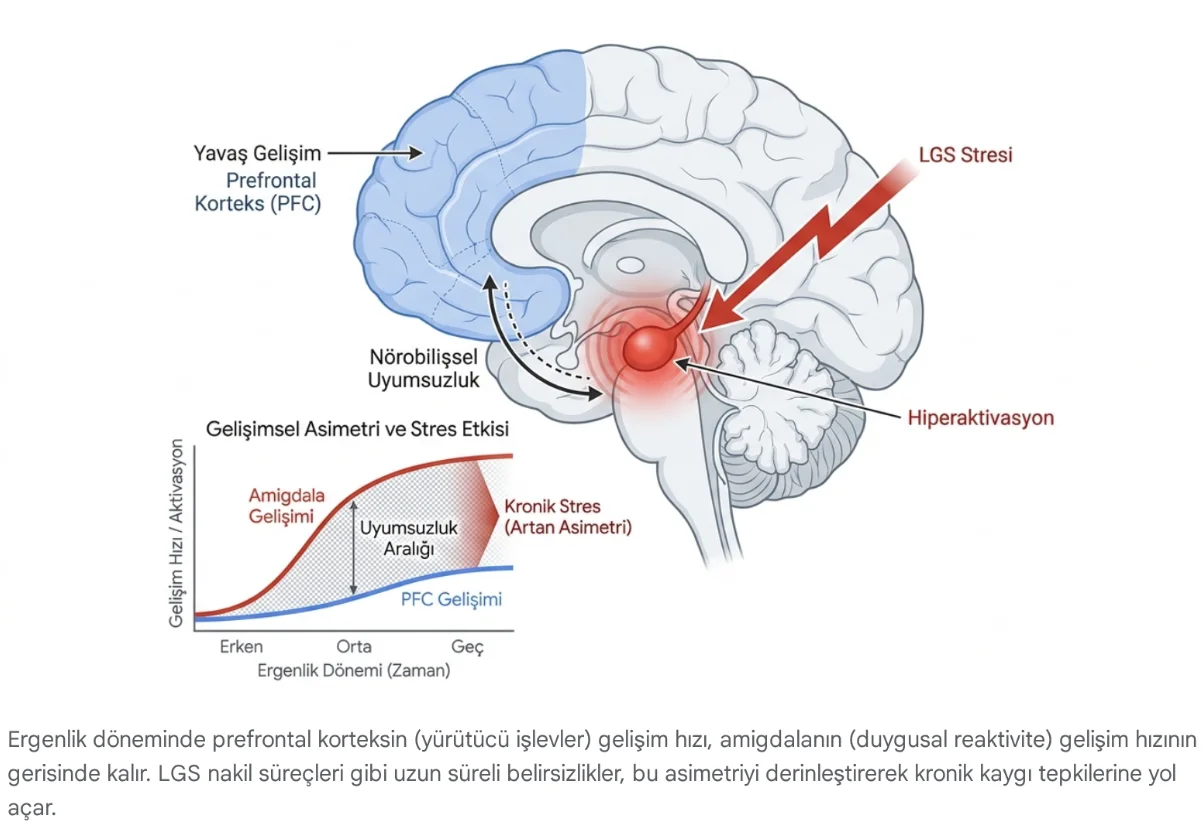
While examining the 2026 base scores lists is a rational process for many parents, the adolescent brain has not yet reached the biological maturity to handle this rationality. Adolescence is a phase where the brain structurally reorganizes through synaptic pruning processes. According to the "Neurocognitive Mismatch" hypothesis in neuropsychiatric literature; while the Amygdala, responsible for threat perception and emotions, works at full capacity in early adolescence, the Prefrontal Cortex, which provides logical thinking and impulse control, has not completed its development until the twenties. This asymmetric development leads to high emotional reactivity. Therefore, placement calculations made by looking at the 2026 Turkey high school base scores list pose not a rational process, but a great neurological threat to the child through the hyperactivation of the amygdala.
The Question of "What is a Percentile?" and Intolerance to Uncertainty
So, what is a percentile? While theoretically mathematical data showing a student's ranking nationwide, in practical psychology, for an adolescent in the LGS process, it turns into an existential label symbolizing their personal worth. The long waiting phase during LGS transfer processes directly triggers a condition known in literature as "Intolerance of Uncertainty". Especially students aiming for highly competitive schools experience catastrophizing cognitive distortions like "My life will be ruined if I don't get into the school I want" when they cannot reach their expected percentile. Never allow your child to measure their existential worth through the school they will attend.
Social Comparison: The "LGS Champion" Illusion and Defectiveness Schema
According to the Ministry of National Education, out of over 1 million participating students in the massive exam held on June 13 with a participation rate of 97.23%, only 452 students scored a perfect 500 points. The LGS champion interviews echoing on television and social media (for instance, the success stories of students from Niğde, Erzincan, and Denizli) unknowingly create a pathological comparison syndrome in families. Parents' efforts to compensate for their own anxieties through the child result in comparing their own child with the LGS champions.
According to Schema Therapy theory, such parental expectations and comparisons activate "Defectiveness and Failure Schemas" in adolescents. The person whose failure schema is triggered believes that their intelligence and capacity are inadequate. When the defectiveness schema is activated, the adolescent may develop three maladaptive coping strategies against this threat: Surrender (withdrawing entirely from academic competition and stopping studying), Avoidance (social isolation and obsessively avoiding discussing preference results), or Overcompensation (criticizing others by giving excessive importance to success with a narcissistic attitude).
Adolescent Anxiety Observation Test (Mini-SCARED)
Evaluate by considering the behaviors your child exhibited during the LGS exam, preference, and placement process.
1. My child suddenly gets scared or startled; gives physical reactions such as shortness of breath or sweating during stressful moments.
2. Extremely anxious about going to any academic environment involving expectations (school/course); produces somatic complaints like headache to avoid going.
3. Thinks about the worst possibilities about preference results, transfers, and everything in general in an unstoppable way.
4. Strongly avoids getting together with relatives or social environments where they think they will be judged; feels intense apprehension about being asked exam results.
5. Has extreme difficulty separating from me or people they feel safe with due to future anxiety; has an unusual fear of staying home alone.
* This module is not diagnostic, it is designed for parental awareness and screening purposes.
Concrete CBT-Based Intervention Strategies for Parents
According to Cognitive Behavioral Therapy (CBT) principles, anxiety is addressed not by suppressing emotions, but by changing dysfunctional belief systems (cognitive restructuring). You can apply these concrete strategies at home:
| Triggering Situation | Adolescent's Automatic Thought | Undesired Parent Reaction | CBT-Based Intervention |
|---|---|---|---|
| Taking an exam or evaluating test results | Tendency to judge success focusing solely on the exam result and score | Asking the child "What did you score?" and focusing only on the result | Praise the effort, not the result. Shift focus to the process by asking "How much effort did you put in today?" |
| Exam successes of other students, friends, or relatives | Anxiety of feeling inadequate by comparing their own capacity with others | Comparing the child with others and measuring success against a general standard | Stop comparing completely. Evaluate the child solely on their own progress; emphasize that learning pace and capacity are unique to the individual. |
| Making mistakes during studying or practice exams | Belief that mistakes are a disaster, a punishment, or an indicator of absolute failure | Evaluating mistakes as a reason for punishment or a sign of inadequacy | Teach that making mistakes is normal. Reframe mistakes not as a reason for punishment, but as identifying knowledge gaps. |
1. Cognitive Restructuring: From Result-Oriented to Process-Oriented
Instead of asking result-oriented questions based on rankings in the MEB system, use communication that glorifies effort. Instead of evaluating your child solely through LGS results and base scores, strengthen their internal locus of control by saying "I know you put in your best effort today". Cognitively stretch your child's "all or nothing" black-and-white cognitive distortions.
2. Gradual Activation and "Worry Time" (Worry Postponement)
To prevent future scenarios and rumination from spreading throughout the day, set a specific "Worry Time" (e.g., 18:00 - 18:30). When your child brings up the topic outside these hours, draw a boundary with a compassionate but clear tone saying, "We are not in the planned time frame to think about this now, we will analyze it in detail at 6 PM" and direct them to physical or neutral activities.
3. Extinguishing Comparison with Radical Acceptance
Keeping the schools others get into or relatives' scores on the agenda carries the defectiveness schema to a pathological level. Fully approve of your child's percentile and the school they are placed in without setting any conditions (Radical Acceptance). Restructure family dialogues not over academic status, but over the adolescent's intellectual interests and personal skills.
Psychological Assessment Module: Parent Awareness Test
The prolonged uncertainty process during the LGS transfer and placement period creates a major stress burden on the neurobiological development of individuals in adolescence. If you observe excessive somatic symptoms (panic/somatic anxiety) or intense school refusal/avoidance in your child, it is essential to get professional psychological support. You can instantly evaluate your child's current situation with scientific parameters through the interactive Adolescent Anxiety Observation Test (Mini-SCARED) provided above.
Frequently Asked Questions (FAQ)
My child didn't reach their expected percentile in LGS, how should I react?
Do not measure your child's personal worth by their percentile. According to CBT principles, focus on the study process and effort rather than the outcome, and make your child feel your unconditional support.
Why is it harmful to compare my child with LGS national champions?
According to Schema Therapy, this triggers the "Defectiveness and Failure Schema" in adolescents. The child may develop maladaptive coping strategies against this mental threat, such as stopping studying completely, having anger outbursts, or avoiding social environments.
How can the uncertainty stress during the LGS preference and transfer period be managed?
In the adolescent brain, the development of the amygdala (emotion) and prefrontal cortex (logic) is mismatched, so they cannot tolerate uncertainty. To manage this stress, you should apply the "Worry Time" rule where you discuss the topic only during a specific time frame (e.g., 6:00 PM - 6:30 PM) during the day.
Scientific Sources Used
- Birmaher, B. et al. (1997, 1999). Screen for Child Anxiety Related Emotional Disorders (SCARED).
- MEB 2026 Preference Guide and Transfer Processes Bulletin.
- Investigation of the Relationship between Early Maladaptive Schemas and Academic Expectations Stress - ResearchGate.
- Cognitive Flexibility and Intolerance of Uncertainty as Predictors of Career Anxiety in Adolescents - DergiPark (2026).